NEW DELHI, Saturday, November 28, 2026, 1:31 PM IST
A new date for the hilltop ceremony
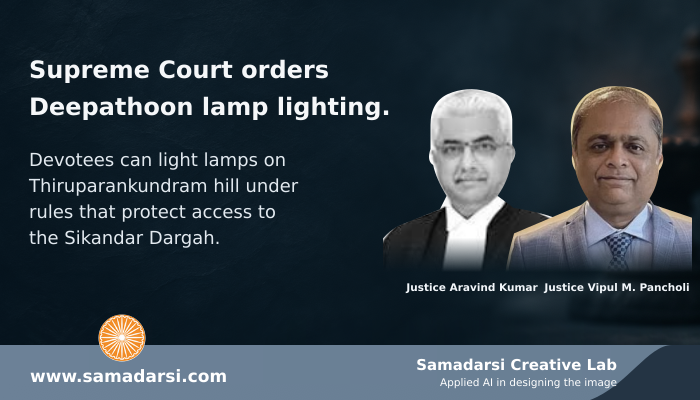
The Supreme Court on Friday, November 27, ordered that the Karthigai Deepam lamp be lit on Saturday, November 28, at the Deepathoon, a stone pillar on Thiruparankundram hill in Madurai. Justices Aravind Kumar and Vipul M. Pancholi asked two former judges to set the time with the sthanikars, or hereditary temple officials.
The court said the flame lit on November 24 at the Uchipillaiyar Mandapam could be used if it was still burning. Senior advocate Guru Krishna Kumar told the judges it had gone out. The court directed that a fresh flame be lit if that was the case.
Every devotee can light a lamp at a designated spot, with a buffer of at least 50 metres around the Sikandar Dargah. The Central Reserve Police Force will guard the hill and both places of worship so devotees can pray freely. Madurai police will guard the surrounding area. Earlier safeguards on public gatherings, fire safety and protection of the monument continue to apply alongside the new directions.
How the first lamp-lighting plan fell through
The dispute goes back to a civil suit filed in 1920. The Privy Council upheld the decision in that suit on May 12, 1931. The present appeals concern a Madras High Court ruling from January 6, 2026. On November 20, the Supreme Court temporarily paused the High Court’s findings and allowed a small team authorised by the temple administration to light the lamp at the Deepathoon on November 24. The Madurai district collector was to coordinate the ceremony.
On November 24, devotees asked the Madurai Bench of the High Court to direct officials to let them watch the ceremony. They challenged restrictions imposed under Section 163 of the Bharatiya Nagarik Suraksha Sanhita, 2023. That section allows magistrates to issue urgent orders to prevent danger or protect public peace. The collector’s lawyer assured the High Court that the Supreme Court order would be followed.
Citing longstanding customs and religious rules, the temple trustees decided to light the lamp only at its usual spot near the Uchipillaiyar Temple. It was lit there at about 6 PM. The Deepathoon lamp remained unlit.
What the two sides told the judges
The connected cases included Hindu Dharma Parishad’s petition against the Union of India and others, along with cases involving Rama Ravikumar and Hindu Shree Foundation. A. Karthikeyan, Rama Ravikumar and V. Ramasubbu brought proceedings naming officials including Madurai Collector Nishant Krishna and Hindu Religious and Charitable Endowments Commissioner T.G. Vinay.
Senior advocates Guru Krishna Kumar, J. Sai Deepak, P. Valliappan and S. Sriram argued that officials had deliberately blocked the ceremony. They asked the court to replace the trustees and have the lamp lit before the Tamil month of Karthigai ended. Solicitor General Tushar Mehta, appearing for the Archaeological Survey of India, backed independent temple management and central security. He said an archaeology official had been stopped from reaching the pillar.
Gopal Sankaranarayanan, appearing for the collector, said the collector had taken steps to comply and asked the judges to wait for his final report. He said the collector’s assurance to the High Court concerned compliance with the Supreme Court order. Sidharth Luthra, appearing for Madurai’s police commissioner, said 5,797 personnel had been deployed. Jaideep Gupta said the temple’s executive officer had no power to overturn the trustees’ decision on a religious matter. Abhishek Manu Singhvi, appearing for the endowments commissioner, said the earlier order had given the trustees some room to decide. Prashanto Chandra Sen also appeared for the respondents, with state lawyer B. Karunakaran assisting.
Why the court called for answers
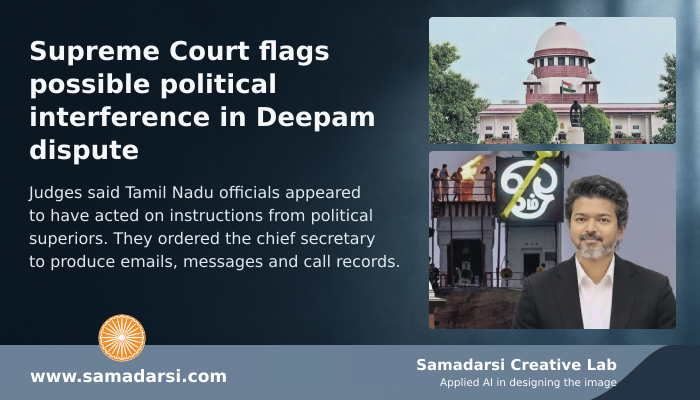
The judges said the unlit lamp, the trustees’ decision and the assurance given to the High Court together gave them initial grounds to suspect deliberate disobedience. They said they had already heard detailed arguments about temple traditions. They found the collector’s first report and apology unsatisfactory, saying he had the power to act and had shifted responsibility to the temple administration. The judges said officials appeared to have acted under political instructions. They directed Tamil Nadu Chief Secretary M. Sai Kumar to file a sworn account with relevant emails, messages and call records.
The bench said court orders bind officials and institutions until the court changes them. It referred to the Constitution’s Preamble and a 2006 ruling, T.N. Godavarman Thirumulpad v. Ashok Khot, which said that everyone is subject to the law and that defying court orders weakens it. Article 144 requires civil and judicial authorities across India to help carry out Supreme Court orders. Article 129 makes the Supreme Court a court of record and gives it power to punish contempt. The judges also cited the Contempt of Courts Act, 1971. In this case, the question is whether officials and trustees knowingly disobeyed a court order.
Who takes charge and what happens next
The Supreme Court suspended the temple board and gave immediate charge to S. Vaidyanathan, a former Chief Justice of the Meghalaya High Court, and V. Parthiban, a former Madras High Court judge. As joint receivers, they will run the temple under the court’s authority, follow its rituals and applicable law, and carry out the lamp-lighting order. The state must support them.
The judges also lifted the temporary pause on the January 6 High Court ruling. The new order sets rules for this ceremony and protects access to both places of worship. Questions about ownership, religious custom and how future festivals will be held remain open in the appeals.
The court asked 14 people to explain why contempt proceedings should not start. They include state police chief Mahesh Kumar Aggarwal, endowments secretary V. Rajaraman, commissioner T.G. Vinay, collector Nishant Krishna, Madurai police officers S. Rajendiran, Inigo Vijayan and N. Devanathan, endowments joint commissioner R. Pon Swaminathan, temple executive officer G. Selvi, board chair V. Shanmugasundaram and trustees C. Rajapandian, K. Azhagappan, K. Regina Devi and K. Chitra. The notices must be delivered within five days, and sworn replies are due within 10 days of delivery. The 14 and the chief secretary, who was called to provide records and explain what happened, must appear in person on December 15 at 2 PM.