NEW DELHI, Saturday, November 28, 2026, 2:26 PM IST
Court praises Dalal for raising the issue
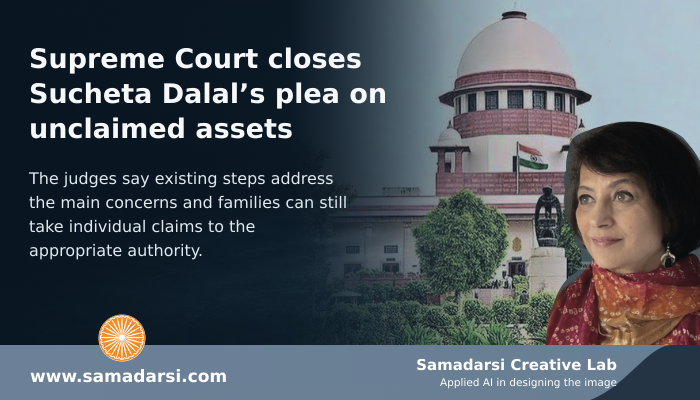
The Supreme Court on Friday, November 27, closed financial journalist Sucheta Dalal’s case on money and investments left unclaimed after a person’s death. Justices Vikram Nath and R. Mahadevan said steps taken by the Union government, the Reserve Bank of India (RBI) and the Securities and Exchange Board of India (SEBI) had addressed the main concerns. The judges said further court directions were unnecessary.
The bench praised Dalal for using a public interest litigation, or PIL, to raise a problem affecting depositors, investors and their families. It also praised her lawyer, Prashant Bhushan, for pursuing the case. The judges had finished hearing arguments and reserved their decision on November 17.
Why Dalal wanted one place to search
Dalal filed the case in 2022 against the Union of India and others. She asked the court to direct the Centre, the Ministry of Corporate Affairs, the RBI and SEBI to make information available on one searchable website. Her petition covered money moved to the Depositor Education and Awareness Fund, the Investor Education and Protection Fund, and the Senior Citizens’ Welfare Fund.
Bhushan said heirs and nominees may have no idea what assets a deceased person left behind or which institution holds them. He asked for a single search covering bank deposits, securities such as shares, insurance policies and provident fund accounts. He said the existing tools fell short, especially for insurance. The court asked why families could not get information about a deceased person’s unclaimed bank accounts. It also considered privacy and the risk of fraudsters posing as heirs.
Centre says ₹6,453 crore in assets returned
Additional Solicitor General N. Venkataraman, appearing for the Centre, said companies must disclose unclaimed deposits under the Companies Act. The public can view those disclosures on the Investor Education and Protection Fund Authority’s website. He said more than three lakh claims had been processed by March 2026, with 10 per cent still pending. In 2025–26, ₹52.85 crore in unclaimed dividends and 3.58 crore shares were transferred to the fund.
Under Section 26 of the Banking Regulation Act, banks must report accounts that have been unused for ten years to the RBI. The Centre also pointed to a 2025 law change allowing up to four nominees for a bank deposit. From October to December 2025, the Department of Financial Services ran a nationwide campaign to help people trace bank deposits, insurance payouts, mutual funds, dividends and shares. The Centre said rightful owners had recovered assets worth ₹6,453 crore by April 18, 2026.
Separate search tools for deposits and mutual funds
Senior advocate Dama Seshadri Naidu, appearing for the RBI, said its UDGAM portal covered 30 banks and about 90 per cent of unclaimed bank deposits. He said the RBI had made the site easier to use after receiving public feedback. Bhushan argued that families might not know which bank held the money. The RBI’s lawyer said users could select all participating banks in a single search.
Advocate Amarjeet Singh Bedi appeared for SEBI. The regulator said its MITRA portal helps investors, nominees and heirs trace inactive or unclaimed mutual fund investments. SEBI also runs public awareness campaigns.
Families can still pursue individual claims
The judges recorded the assurances given by the authorities in their sworn statements. They said keeping the case open to monitor steps already taken would serve little purpose. They expect the authorities to make unclaimed assets easier to find and the claims process faster and clearer.
The court closed the case without ordering the single database Dalal had sought. People with a specific complaint can still take it to the authority responsible for handling that claim.