NEW DELHI, Saturday, November 28, 2026, 2:48 PM IST
Victims get a chance to raise safety concerns
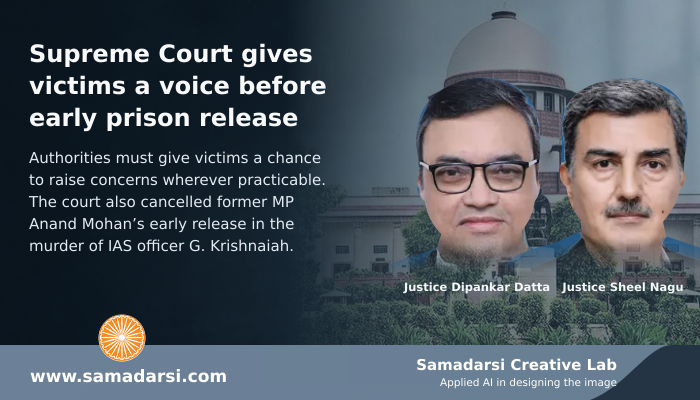
The Supreme Court ruled on Thursday, November 26, that before deciding whether to release a prisoner early, authorities must, wherever practicable, notify a victim who can be identified and reached, or the victim’s recognised legal representative. They must give that person a reasonable chance to submit facts, objections or concerns and consider those views alongside the other information in the case. Justices Dipankar Datta and Sheel Nagu said this safeguard should be read into the prison manual. Remission reduces the punishment a convicted person still has to serve and can lead to early release.
The judges said victims may know about threats, harassment, the prisoner’s conduct or other developments that could affect their safety. Article 21 of the Constitution protects life and personal liberty. The court said authorities must weigh the prisoner’s liberty alongside the victim’s or family’s right to live with dignity and without fear. The authority makes the final decision under the applicable law and release policy.
How the murder case reached the Supreme Court
On December 5, 1994, Gopalganj District Collector G. Krishnaiah was returning from an official meeting in a neighbouring district when a mob overturned his car and attacked him. A man shot him after Anand Mohan, then a Bihar legislator, and others urged him to do so. The gunman was killed in 1997 while the trial was under way.
A Patna sessions court convicted Mohan on October 1, 2007, under Sections 302 and 109 of the Indian Penal Code. These sections deal with punishment for murder and for helping or encouraging a crime that is then committed. The court sentenced him to death on October 3. Under Section 366 of the then Code of Criminal Procedure, the High Court had to confirm the sentence before it could be carried out.
On December 10, 2008, the Patna High Court upheld the conviction and changed the sentence to rigorous life imprisonment. It found that the case fell outside the narrow category in which the death penalty is used. On July 10, 2012, the Supreme Court dismissed appeals by both Bihar and Mohan.
A rule change opened the way to release
Mohan first sought early release in 2021, when Rule 481(i)(a) of the Bihar Prison Manual barred consideration in cases involving the murder of a public servant on duty. Bihar removed that restriction on April 10, 2023. Mohan applied again the same day. A probation officer submitted a report on April 13, the superintendent of police made a recommendation on April 14, and the State Sentence Remission Board met on April 20. Bihar granted early release on April 24.
Krishnaiah’s widow, Telugu Umadevi Krishnaiah, challenged the rule change and the release order under Article 32, which lets people approach the Supreme Court to enforce fundamental rights. Former IAS officer K.J. Alphons joined her petition and argued in person. The petition also sought prison and release records and asked the authorities to consider moving Mohan to a prison outside Bihar and drawing up uniform early-release guidelines.
Siddharth Luthra and Tanya Shree appeared for the widow. The judgment names senior counsel Kumar for Bihar, Baghel for the Remission Board and Dwivedi for Mohan. The petitioners questioned the reasons for the rule change and whether officials had properly assessed Mohan’s record. Bihar and Mohan relied on his good conduct. Bihar also pointed to other states without a similar restriction.
Why the judges struck down Bihar’s decision
The court found that Bihar had removed one restriction from a policy it had followed since 2002 without showing a sound public reason for doing so. It struck down the change under Article 14, which guarantees equality before the law and protects against arbitrary government action.
The judges also found that Bihar relied on a judge’s opinion from 2021, when Mohan was ineligible for consideration. Section 432(2) of the then Code of Criminal Procedure required a fresh, reasoned opinion for the 2023 decision. The court drew on Ram Chander v. State of Chhattisgarh, which said a judge recommending whether to grant remission must give reasons. Good conduct was one factor, and officials still had to follow the legal process. The court left open the broader question of when a prisoner can rely on a later, more favourable policy.
Mohan must surrender within one month
The Supreme Court gave Mohan one month from the judgment to surrender. If he fails to do so, authorities must take him into custody. Bihar may consider a fresh request for early release. Before deciding, it must give Umadevi a reasonable chance to submit her views and consider them. Any move to revise Rule 481 must wait until Mohan surrenders or is taken into custody.
Section 473 of the Bharatiya Nagarik Suraksha Sanhita gives the government power to pause a sentence or reduce the punishment still to be served. The section leaves victim notification unaddressed. The bench drew on Jagjeet Singh v. Ashish Mishra, which recognised victims’ right to take part in criminal proceedings from the investigation through an appeal or review by a higher court. The ruling gives victims a chance to raise concerns at the early-release stage as well.