NEW DELHI, Saturday, November 28, 2026, 3:09 PM IST
Bail comes with a clear condition
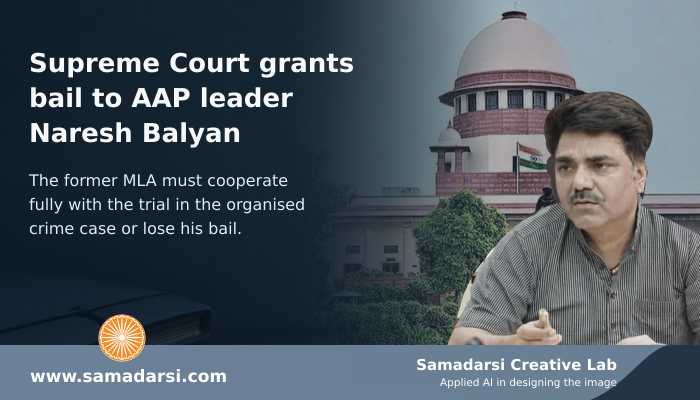
The Supreme Court on Friday, November 27, granted bail to Aam Aadmi Party leader and former MLA Naresh Balyan in a case brought under the Maharashtra Control of Organised Crime Act, known as MCOCA. Justices Vikram Nath and Aparesh Singh directed Balyan to cooperate fully with the trial. They warned that they would withdraw bail if he failed to do so.
Police allege links to an extortion ring
The Delhi Police Crime Branch registered the case on August 28, 2024, under Sections 3 and 4 of MCOCA. It arrested Balyan on December 4 that year. Section 3 punishes organised crime and related acts, including knowingly helping a crime group carry out an offence. Section 4 punishes holding unexplained wealth on behalf of a member of such a group.
Prosecutors allege that Balyan helped a group led by Kapil Sangwan, who is on the run. They link the group to shootings, threats and extortion. They say it threatened business owners and property dealers for money and pressured landowners to sell plots for less than they were worth.
Why the lower courts refused bail
The trial court refused Balyan bail on January 15 and May 27, 2025. The Delhi High Court rejected his appeal on August 3, 2026, saying the available evidence pointed to a possible link with Sangwan’s group. The court referred to about 17 police cases connected to the group’s activities.
Balyan argued that prosecutors had relied on older police cases and charge sheets without showing a fresh unlawful act by him or establishing that he belonged to the group. The High Court said the requirement for more than one charge sheet taken up by a court in the previous ten years applied to the group as a whole. It also rejected Balyan’s argument that the separate case amounted to double jeopardy, which protects against being prosecuted and punished again for the same offence. The judges said police can add MCOCA provisions to an existing case or register a separate case with the required approval.
The High Court said that when prosecutors oppose bail under Section 21(4), the court must have reasonable grounds to believe the accused is not guilty and is unlikely to commit an offence while on bail. It recognised Balyan’s right to a speedy trial but said time spent in custody alone could not decide the bail request.
Defence says two witnesses withdrew their statements
Senior advocate Vikas Singh, appearing for Balyan, said two key witnesses had withdrawn their statements. He said Balyan was initially left off the list of accused and argued that the evidence relied on could not legally be used. Singh also said Balyan had previously complained against Sangwan and received police protection after threats.
Justice Nath questioned the prosecution about pursuing an elected representative. Additional Solicitor General Raja Thakare, appearing for Delhi, said the case involved extortion and property grabbing. He argued that the law focuses on the group’s activities and told the court that it faced 19 cases.
Disclaimer: The information published on timesmonitor.com is provided for general news, informational, educational, and public awareness purposes only. While every reasonable effort is made to ensure the accuracy, reliability, and timeliness of the content, Samadarsi Communication LLP does not guarantee that all published information is free from errors, omissions, or inaccuracies. The views and opinions expressed in opinion articles, guest columns, interviews, and reader comments are solely those of the respective authors and do not necessarily reflect the views of Samadarsi Communication LLP. Readers are encouraged to independently verify any information before making financial, legal, medical, political, or personal decisions based on the content published on this website. Samadarsi.com reserves the right to update, modify, correct, or remove any content at any time without prior notice. Any links to external websites are provided solely for the convenience of users, and we do not endorse or accept responsibility for the content, security, accuracy, or privacy practices of such third-party websites. All trademarks, logos, images, and other copyrighted materials appearing on this website remain the property of their respective owners.