NEW DELHI, Saturday, November 28, 2026, 2:38 PM IST
Judges press officials for an explanation
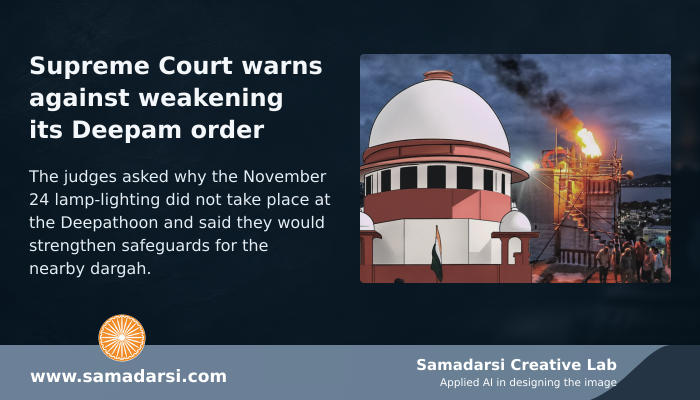
The Supreme Court on Friday, November 27, questioned Tamil Nadu officials over why the Karthigai Deepam lamp was not lit at the Deepathoon, a stone pillar on Thiruparankundram hill in Madurai. The court’s November 20 order had allowed a small team authorised by the temple administration to light the lamp there on November 24.
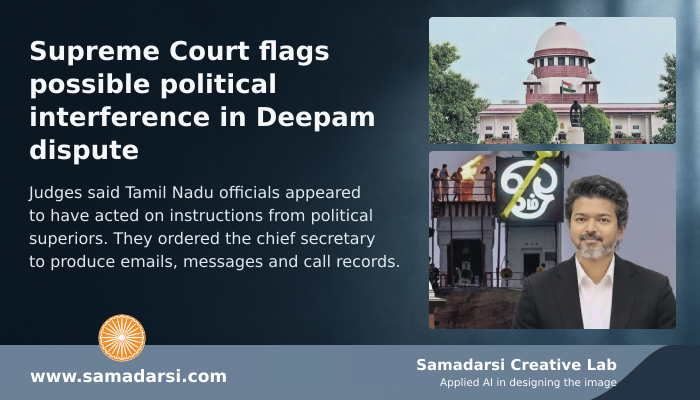
Justices Aravind Kumar and Vipul M. Pancholi heard petitions alleging that Madurai District Collector Nishant Krishna and other officials had deliberately disobeyed the order. They also heard requests to hold the ceremony on another day during the Tamil month of Karthigai. Justice Kumar said the hearing would focus on whether the earlier order had been followed. He warned that no one, whatever their position, could weaken a court order.
Petitioners say officials relied on the trustees’ decision
Senior advocate Guru Krishnakumar said the collector, police commissioner, temple administration and state endowments department had a duty to arrange the ceremony. He argued that the collector relied on a decision by the recently appointed temple board to light the lamp at its usual spot. He said that decision surfaced around 7:30 PM, after the scheduled ceremony. He also said the collector had failed to consult the Archaeological Survey of India and that hereditary temple officials said the trustees had not consulted them. He asked the court to replace the board and have the lamp lit during the festival.
J. Sai Deepak, appearing for V. Ramasubbu, said the order fixed the site and gave the trustees no choice over where to hold the ceremony. He argued that officials still had to follow the order if trustees raised religious rights under Articles 25 and 26 of the Constitution. Article 25 protects freedom to practise religion. Article 26 protects a religious group’s right to manage its religious affairs. Both are subject to limits including public order, morality and health.
Deepak said he had consulted scriptural experts and argued that the lamp should burn for five days from December 5. P. Valliappan, appearing for Rama Ravikumar, alleged that a court order had also been breached the previous year. He said the lamp could be lit on any day of Karthigai, which he said ends on December 15.
Collector says trustees never authorised a team
Gopal Sankaranarayanan, appearing for the collector, said officials had taken the necessary steps but could not go ahead without a team authorised by the trustees. He asked the judges to wait for the collector’s full report. He said video showed archaeology officials inspecting the site and that the trustees had signed the resolution. The temple’s executive officer, he said, had signed the press release.
Justice Kumar pointed to the collector’s formal assurance to the Madras High Court. Sankaranarayanan said the collector had promised to comply with the Supreme Court order. Sidharth Luthra, appearing for Madurai’s police commissioner, said police had decided against requesting central forces. Jaideep Gupta said the temple’s executive officer handled administration and could not override the trustees on religious matters.
Abhishek Manu Singhvi, appearing for the state endowments commissioner, said officials might have misunderstood the order and denied that they had planned to defy it. Justice Kumar rejected Singhvi’s argument that the order gave trustees room to decide.
Solicitor General calls for independent supervision
Solicitor General Tushar Mehta, appearing for the Archaeological Survey of India, argued that asking a court to review an order does not suspend it. He said officials should put matters right by holding the ceremony before the court heard their defence. The collector’s lawyer said the judges would first have to find initial grounds for contempt.
Mehta argued that the conduct could amount to both civil and criminal contempt. Civil contempt includes deliberately disobeying a court order or breaking a formal promise made to a court. Criminal contempt can include conduct that obstructs the work of the courts. Mehta asked for an agency outside the state government’s control to oversee compliance and report back, with a neutral person such as a former judge supervising the ceremony.
Shared steps prompt a call for stronger safeguards
Huzefa Ahmadi, appearing for the Sikandar Badushah Dargah, said the same steps lead to the dargah and the Deepathoon. He asked for stronger safeguards if the lamp-lighting went ahead. He said the dargah usually receives about 100 to 200 visitors a day and would hold its Urs observance on December 10. Justice Kumar said the concern was justified and that safeguards would be strengthened.
In its written order, the court directed that the lamp be lit on November 28. It set a buffer of at least 50 metres around the dargah for lamp-lighting and placed the Central Reserve Police Force in charge of security on the hill. The court suspended the temple board, appointed two former judges to run the temple and asked 14 people to explain why contempt proceedings should not begin. The next hearing is on December 15 at 2 PM.